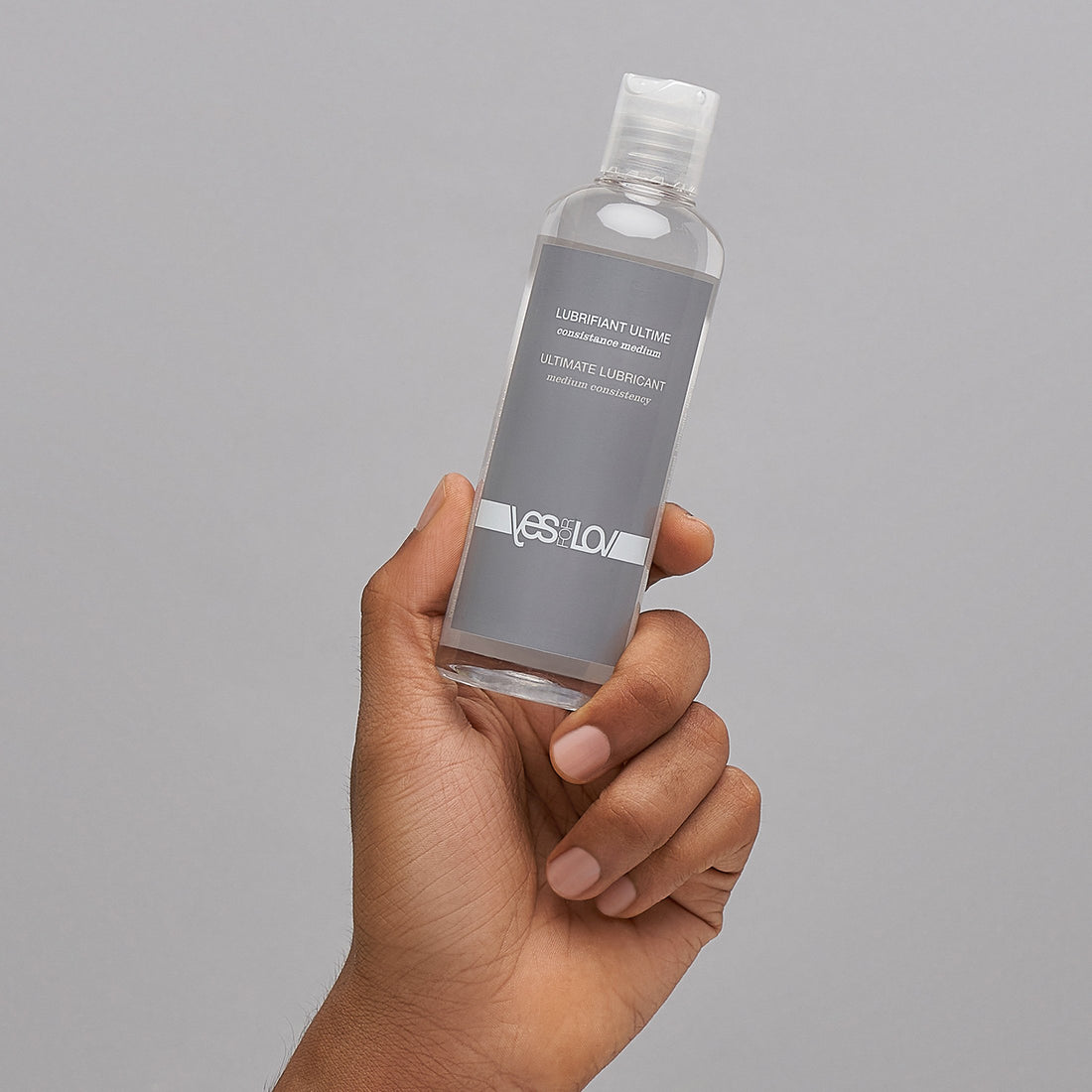
In recent years, an idea has slowly taken root in people's minds: what is natural must necessarily be better. So we replace. We substitute. We test, we experiment. Coconut oil, petroleum jelly, moisturizing creams, cooking oils... In short, anything slippery and natural would be an alternative to YESforLOV intimate lubricants.
On forums and social media, tips are multiplying, each more innovative than the last. But what we often forget is that the vaginal epithelium is not like other skin. Sensitive and imbalanced, your intimate microbiota lives like an ecosystem. A fragile architecture where the slightest imbalance can have consequences that last much longer than the moment itself.
Coconut oil: the paradox of the "too perfect" lubricant
Coconut oil is beautiful. White, shiny, reassuring. It smells clean, sweet, tropical. It has the aura of a universal product, capable of repairing anything. And yet. In intimacy, it poses a problem precisely for the reasons that make it successful elsewhere. It is greasy, occlusive, persistent, antifungal. It doesn't just glide, it settles. And in this closed environment, it can disrupt the natural balance of the vaginal flora.
And added to this is a mechanical reality often forgotten: like all oils, it weakens the latex of condoms. This turns a moment of pleasure into a zone of contraceptive and health vulnerability.
To learn more about the use of intimate lubricants with condoms and to find the condom that's right for you, click here.
The paradox is this: what seems "purest" can be the least suitable. Would you like to know more about the benefits of natural vegetable oils for intimacy? Which lubricating oil to choose? Can a vegetable oil be used as a lubricant? We answer these questions in a dedicated article, available right here.
For those who can't wait, we recommend our natural orange blossom massage lubricant, 100% natural, made with organic oils used in synergy to respect the balance of your precious mucous membranes.
Petroleum jelly: the legacy of comfort that shouldn't leave the bathroom
There's something reassuring about petroleum jelly. A pharmacy product, almost medicinal, associated with the idea of protection. But in intimacy, it acts more as a barrier than as a facilitator. It covers, it insulates, it retains. And above all, it doesn't disappear easily. Some studies in gynecological health have even observed an association between regular use of occlusive products and microbial imbalances. In other words: what provides an immediate gliding sensation can, in reality, potentially disrupt intimate balance over time. To be continued and investigated further to be certain. At YESforLOV, it's NO WAY!
Saliva: the universal reflex... but why saliva is not a good lubricant
It is probably the oldest improvised lubricant in the world. Also the most instinctive. And yet, one of the most ineffective, and one of the worst natural lubricants to use. Saliva gives an impression of "wetness," but it disappears almost immediately. Worse, it dries out the mucous membrane and sometimes leaves more friction than it avoids. In some cases, it can even accentuate feelings of discomfort. But above all, it introduces a bacterial flora into a fragile space that has no business being there. More alkaline than the naturally acidic vaginal environment, it can disrupt its fragile microbiota and promote certain imbalances.
And that's not all. Saliva carries its own ecosystem of bacteria and can also contain certain viruses, particularly those associated with oral or sexually transmitted infections such as herpes or HPV. Because in intimacy, natural doesn't always mean harmless.
Saliva is not a product designed to lubricate. It's a reflex, and it's a bad one. And the body knows the difference.
Food, sugar, and the confusion of pleasures
There is a very contemporary aesthetic of "food-friendly" sex. Bodies oiled with honey or Nutella, sensory scenographies where pleasure comes through the mouth as much as through touch. But the line is fine between play and daily use. Sugar, for example, is not neutral in an intimate environment. It alters microbial balances, promotes certain proliferations, and can transform a sensual experience into a biological imbalance. Even greasy or milky textures, often perceived as soft and sensual, are not suitable for internal use. What is edible is not necessarily penetrable, and vice versa.
What is striking, ultimately, is not so much the existence of these practices as their trivialization. Because they are not isolated cases. They stem from a lack of information. We talk a lot about sexuality today. About desire, communication, consent, female pleasure. But much less about intimate mechanics, compatibility, and respect. About what touches, rubs, irritates, protects, or weakens. And in this silence, "homemade solutions" find their place.
Most mistakes do not come from conscious risk-taking. They come from an intuition.
"If it slides, it must work."
"If it's natural, it must be safe."
"If I use it on my skin, I can use it elsewhere."
This is precisely where the danger lies, because the intimate body does not follow the same rules as the skin. It does not forgive repeated approximations. And it does not distinguish between intention and result. The good news is that there is something very contemporary about the return of lubricant as a central object of sexual well-being. Long perceived as secondary, even taboo, it is now an assumed product, integrated into a broader vision of sexuality: aesthetic, sensual, conscious.
No longer an "emergency fix." But a gesture of care. An ally for the body, a game-changer for sexuality, just like a skincare product or a perfume. In a world obsessed with natural, DIY, and transparency, there is a simple but often forgotten truth: not everything natural is always suitable for your intimacy. And not everything accessible is meant to be used. Pleasure does not need to be simplified. It needs to be respected. And sometimes, that starts with a very concrete action: choosing what has been designed for it. At YESforLOV, it's even an obsession. Our intimate lubricants are formulated in France, tested under gynecological control, with a pH adapted to mucous membranes, and designed as true objects of pleasure, not as emergency products.